

The Trinity Reimagined
Not a Puzzle to Solve, but a Life to Enter

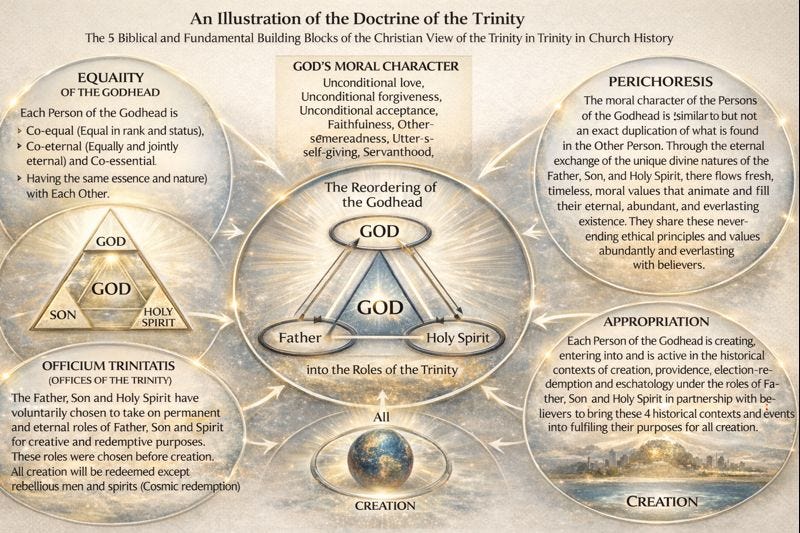
Abstract
For many Christians, the doctrine of the Trinity feels either confusing, abstract, or functionally irrelevant—something affirmed in creeds but rarely connected to daily faith, prayer, or discipleship. This article proposes a different way forward. Rather than treating the Trinity as a philosophical riddle, it presents the triune God as a living communion of love whose eternal life overflows into creation, redemption, and new creation. Drawing from a biblical framework that emphasizes the equality of the Godhead, relational indwelling, divine roles, historical action, and God’s moral character, this essay reframes the Trinity not as a problem to explain but as the very shape of reality Christians are invited to inhabit.
Introduction: Why the Trinity Feels So Distant—and Why It Shouldn’t
Ask the average Christian what the Trinity means, and you’ll often get one of two responses. Either you’ll hear a memorized formula—“one God in three persons”—or an embarrassed admission that the doctrine feels confusing and impractical. The Trinity is frequently treated as a theological speed bump: something you’re supposed to affirm quickly before moving on to more “useful” topics.
But Scripture does not treat God’s triune nature as a footnote. The biblical story assumes it. Creation, covenant, incarnation, redemption, and renewal all unfold through the coordinated presence and action of Father, Son, and Spirit. The problem is not that the Trinity is too complex; it’s that we’ve often tried to explain it in ways that flatten its depth or detach it from lived faith.
What if the Trinity is not primarily a metaphysical formula, but a revelation of God’s eternal life? What if it tells us not only who God is, but how God loves, how God acts, and what kind of life God shares with His people?
When viewed through that lens, the Trinity stops being an abstract doctrine and becomes the grammar of the gospel itself.
Equality Without Competition: One God, Fully Shared
At the heart of the Trinity stands a radical claim: Father, Son, and Spirit are fully and equally God. None is more divine than another. None possesses a higher rank, greater authority, or superior essence. Each shares fully in the one divine life.
This matters more than we often realize. Many misunderstandings about the Trinity arise from importing human power structures into God. We assume that difference must imply hierarchy, or that authority requires superiority. Scripture resists this instinct. Divine unity does not depend on dominance, and divine order does not require inequality.
The Father is not “more God” than the Son. The Son is not a lesser or secondary deity. The Spirit is not an impersonal force or divine afterthought. All three share the same divine essence, the same eternal life, the same glory.
Equality, however, does not mean sameness. The divine Persons are not interchangeable masks worn by a single actor. They are genuinely distinct in relation, yet inseparable in being. This distinction without division is not a logical contradiction—it is the very heartbeat of biblical monotheism.
Perichoresis: The God Who Dwells in God
One of the most beautiful insights of Trinitarian theology is the idea of mutual indwelling—often described as a dynamic, eternal sharing of life between Father, Son, and Spirit. Rather than existing side by side as separate beings, the divine Persons exist within one another.
This means God is, from all eternity, relational. Love is not something God learns once creation appears. Love is who God is. The Father gives Himself to the Son, the Son responds in faithful devotion, and the Spirit animates, unites, and glorifies. This is not a static arrangement, but a living exchange—an eternal movement of self-giving.
Importantly, this mutual indwelling is moral, not merely metaphysical. God’s power is governed by God’s goodness. God’s sovereignty is animated by God’s love. The divine life is not raw force, but righteous, self-giving life.
This is why Scripture never pits God’s love against His holiness or His mercy against His justice. Within God Himself, these are not competing traits. They are perfectly integrated realities flowing from the triune life.
The Moral Center of Reality
At the center of the Trinity is not control, but character.
God’s moral nature—unconditional love, faithfulness, forgiveness, self-giving, and righteous judgment—is not a response to sin. It is eternal. The triune God has always been other-centered, always oriented toward life, always opposed to what destroys communion and goodness.
Even divine judgment must be understood within this framework. God’s opposition to evil is not arbitrary anger, but the moral resistance of love against what deforms creation. Wrath, in Scripture, is not the opposite of love; it is love’s refusal to coexist with corruption and death.
This moral coherence is why the gospel is not about appeasing a divided God. The Father does not need to be persuaded by the Son to love humanity. The cross reveals what has always been true about God: self-giving love expressed within the triune life and now poured out into history.
The Offices of the Trinity: Order Without Inequality
While Father, Son, and Spirit are equal in being, they are not identical in role. Scripture consistently portrays each Person acting according to a distinct vocation—what can be called the offices of the Trinity.
The Father is the source and initiator of divine purpose. The Son is the visible revelation and mediator of God’s presence. The Spirit is the empowering, indwelling presence of God within creation and God’s people. These roles are not temporary assignments or hierarchical rankings. They are freely chosen, eternal commitments made for the sake of creation.
This is where many discussions go wrong. Role distinction is often confused with inferiority. But in the Trinity, order exists without domination. Authority exists without coercion. Submission exists without loss of dignity.
The Son’s obedience does not diminish His divinity. The Spirit’s glorifying work does not make Him less personal. Each Person expresses the one divine life through a distinct relational posture.
Appropriation: How the One God Acts in History
Although God always acts as one, Scripture often highlights the involvement of specific divine Persons in particular works. Creation is associated with the Father, redemption with the Son, and transformation with the Spirit—not because the others are absent, but because divine action is relationally ordered.
This pattern helps us understand how God works in time without fragmenting God’s unity. The Father creates through the Son by the Spirit. The Son redeems in obedience to the Father and in the power of the Spirit. The Spirit applies redemption by uniting believers to the Son and drawing them into the Father’s life.
The result is not a divided God, but a richly textured divine presence woven through history.
Creation as Invitation, Not Experiment
Creation itself flows from the Trinity. God did not create out of loneliness or deficiency, but out of abundance. The triune God invites creation to participate in the life that already exists within Him.
This is why salvation is more than forgiveness of sins. It is participation. Through the Spirit, believers are united to the Son and welcomed into the Father’s love. Eternal life is not merely endless duration; it is shared communion with the triune God.
The gospel, at its core, is an invitation to step into the life God has always lived.
Why This Changes Everything
When the Trinity is understood this way, theology stops being abstract. Prayer becomes participation, not performance. Worship becomes alignment, not appeasement. Discipleship becomes imitation of divine self-giving, not moral self-improvement.
The Trinity reveals that reality itself is relational, moral, and oriented toward life. And that means Christian faith is not about mastering a doctrine, but about being shaped by a God who is, from all eternity, Father, Son, and Spirit.
Three Questions to Reflect On
How would your prayer life change if you viewed prayer as participation in the triune life of God rather than simply asking for outcomes?
In what ways have you unconsciously projected human power structures onto God—and how does the Trinity challenge those assumptions?
What might it look like for the church to reflect the relational, self-giving life of the Trinity in its worship, leadership, and mission?
Theological Voice help pastors, scholars, and students unite Scripture, scholarship, and Spirit-led technology to see God’s Word with new eyes.
What a beautiful design from our awesome Father!
“Wrath, in Scripture, is not the opposite of love; it is love’s refusal to coexist with corruption and death.” That right there was worth the read. Thank you.