

The Cross Was a Trap
How God’s Hidden Wisdom Defeated the Powers of Darkness

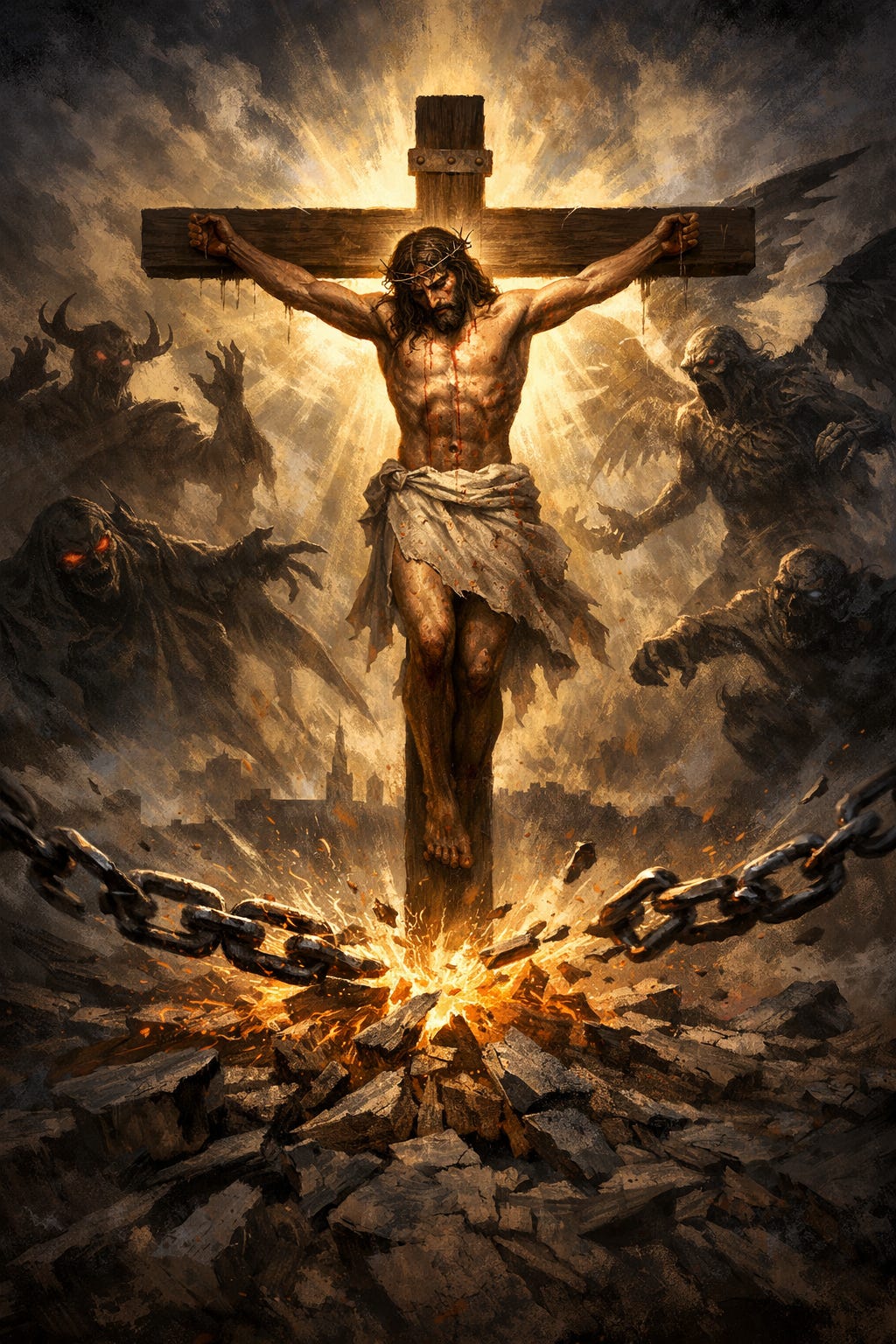
Abstract
The crucifixion of Jesus is often remembered as the darkest moment in human history—the point where injustice, betrayal, and violence converged to execute the Son of God. Yet the New Testament frames the cross in a far more startling way. According to 1 Corinthians 2:7–8, the death of Jesus unfolded within a divine strategy that had been deliberately hidden from the “rulers of this age.” Paul insists that those rulers did not understand what the crucifixion would accomplish. If they had, he writes, they would never have crucified the Lord of glory.
This raises a profound theological question: how could the powers opposing God participate in the central act of redemption while remaining ignorant of its consequences? Scripture suggests that the cross was not simply foreseen by God but concealed within a cryptic strategy embedded throughout the unfolding story of redemption. Even heavenly beings did not fully grasp the mystery. The book of Job hints that God does not place ultimate trust in His heavenly servants, while the New Testament describes angels longing to understand the unfolding drama of salvation. When Jesus was crucified, the powers that opposed God believed they had achieved victory. Instead, they had unknowingly stepped into a trap. The cross became the moment when their authority began to collapse.
Introduction
For many Christians, the cross is primarily understood as the place where Jesus died for the sins of humanity. That truth is central to the gospel. Yet the New Testament presents the crucifixion as something even larger than that. It is not merely the moment when forgiveness became possible. It is also the turning point in a cosmic conflict that had been unfolding throughout the biblical story.
When Paul describes the cross, he does not frame it simply as a tragic event that God later transformed into something good. Instead, he describes it as the revelation of a “secret and hidden wisdom of God.” This wisdom, he says, had been determined before the ages began, yet it remained concealed from the rulers of this world.
Paul’s explanation introduces a remarkable paradox. The crucifixion occurred precisely because the powers opposing God did not understand what it would accomplish. Their ignorance was not incidental. It was central to the success of God’s plan.
This means the cross was not simply an event that God allowed to happen. It was the climax of a strategy that had been unfolding across centuries of Scripture, prophecy, and divine revelation. The story of redemption had been written in such a way that its final meaning could not be fully understood until the moment when it was already accomplished.
The Wisdom That Was Hidden in Plain Sight
The Scriptures of Israel contain countless hints about redemption. The sacrificial system pointed toward the need for atonement. The prophets spoke of a suffering servant who would bear the sins of the people. The psalms described a righteous sufferer who would be vindicated by God. Yet these pieces did not assemble into a clear picture until after the events of the cross and resurrection.
For centuries, readers of the Scriptures encountered these passages without fully grasping how they would converge. Even the disciples of Jesus struggled to understand what He was telling them when He spoke of His coming death.
This was not a failure of interpretation. It was part of the design.
The meaning of the cross was embedded within the biblical story in ways that concealed its ultimate significance until the proper moment. The result was that the decisive act of redemption could unfold without being recognized for what it truly was.
What appeared to be weakness was actually wisdom hidden in plain sight.
The Limits of Heavenly Knowledge
One of the most surprising themes in Scripture is the suggestion that even heavenly beings do not possess complete knowledge of God’s purposes. While angels are often portrayed as powerful servants of God, the Bible does not present them as omniscient.
The book of Job offers an early glimpse into this reality. In Job 4:18, we are told that God “puts no trust in his servants, and his angels he charges with error.” Later in the same book, the text declares that even the heavens are not pure in His sight. These statements remind readers that the wisdom of God surpasses the understanding of every created being.
This means that spiritual powers—whether loyal or rebellious—do not automatically comprehend the unfolding purposes of God. They observe history as it unfolds, but their perception remains limited.
That limitation becomes crucial when we consider the events surrounding the crucifixion.
The powers opposing Jesus could see that His ministry threatened their authority. He proclaimed the kingdom of God. He cast out demons. He exposed corruption and hypocrisy. His presence disrupted the structures through which they exercised influence over humanity.
From their perspective, eliminating Him appeared to be the logical solution.
What they could not see was that His death would accomplish exactly what they hoped to prevent.
Angels Watching the Mystery
The New Testament reinforces this theme when it describes how angels observe the unfolding plan of redemption. In 1 Peter 1:12, the gospel is described as something “into which angels long to look.”
The phrase paints a vivid picture. Angels are portrayed not as beings who fully grasp the mystery of salvation, but as observers who watch the drama of redemption unfold with intense curiosity.
The language suggests investigation and discovery. It implies that even heavenly beings are trying to understand what God is accomplishing through the events of history.
This idea challenges the assumption that the spiritual realm possesses perfect insight into God’s plans. Instead, the biblical narrative portrays even angels as learners within the unfolding story of redemption.
They watch the drama of salvation as it unfolds, gradually perceiving the depth of God’s wisdom.
When the Powers Thought They Had Won
The crucifixion therefore must be understood within this larger cosmic context.
When Jesus was arrested, condemned, and executed, the powers opposing God believed they had succeeded. The Messiah had been publicly humiliated and destroyed. Roman crucifixion ensured that His death would be remembered as a warning to anyone who dared challenge imperial authority.
To human observers, the outcome appeared final.
Jesus had been silenced. His followers fled. His movement seemed finished.
Yet the resurrection exposed the profound miscalculation at the heart of that apparent victory.
The cross had not ended His mission. It had fulfilled it.
Through His death, Jesus confronted the deepest problem of the human condition—sin and the bondage it created. Humanity’s rebellion had severed the relationship between Creator and creation. The fear of death held humanity captive. Systems of power and corruption thrived in that environment of bondage.
The crucifixion addressed that reality directly. By bearing the consequences of sin, Jesus opened the way for reconciliation between God and humanity.
At the same time, the cross undermined the authority of the powers that had exploited humanity’s bondage.
Their influence depended on the continuation of sin and death. When the power of sin was broken and death was overcome through the resurrection, the foundation of their authority began to collapse.
What they believed would eliminate their enemy instead destroyed the very system that sustained their rule.
The cross had become a trap.
The Moment Everything Was Revealed
The resurrection marked the moment when the hidden wisdom of God began to be unveiled. Suddenly, passages of Scripture that once seemed mysterious took on new clarity.
The suffering servant described by the prophets, the sacrificial imagery embedded within Israel’s worship, and the promises of a coming king all converged in the story of Jesus.
The apostles began proclaiming that the crucifixion had always been part of God’s plan.
What had once looked like defeat was now revealed as victory.
The message of the early church centered on this revelation. The cross was not the end of the story. It was the turning point through which God had begun reclaiming the world.
The mystery hidden for ages had been unveiled.
The Wisdom of God
The cross ultimately reveals something profound about the nature of divine wisdom.
God does not always confront evil in the ways that human beings expect. Instead of overwhelming force, He often works through strategies that overturn the assumptions of both humans and spiritual powers.
What appeared to be weakness became the instrument of victory.
What looked like failure became the foundation of redemption.
The wisdom of God proved greater than the understanding of every created intelligence.
The rulers of this age believed they had extinguished the light of the world. Instead, they had unknowingly ignited the moment when their authority would begin to fade.
The cross stands as the ultimate demonstration that the wisdom of God cannot be outmaneuvered.
Questions to Consider
If Paul says the rulers of this age would not have crucified Jesus had they understood the outcome, what does that reveal about the hidden nature of God’s redemptive plan?
What does it mean that angels “long to look” into the mystery of the gospel? How does this shape our understanding of the unfolding story of redemption?
How does viewing the cross as a cosmic turning point change the way we understand the victory of Christ?
Theological Voice help pastors, scholars, and students unite Scripture, scholarship, and Spirit-led technology to see God’s Word with new eyes.
Way back in seminary I was exposed to atonement theories I had not encountered up until that point. The Ransom theory was one of them. At the time it seemed almost comical: Jesus portrayed as bait on a hook, coaxing Satan to bite. And then of course after Satan took the bait defeating him.
As I've continued to study scripture more objectively over the years, Christus Victor and the related Ransom theory definitely has gained traction in my thinking.
Jesus openly spoke of his impending death and subsequent Resurrection to His disciples. Was this private communication that was kept secret from principalities and powers? Or like the disciples were the powers simply incapable of truly perceiving its meaning until they had unwittingly played right into God's hand - doing only what He had foreordained? What's your idea, Dale?
I have sometimes prayed that God would keep secret from the spirits of darkness the ministry outreach plans we were making so that we could arrive and carry on ministry without the difficulties of evil plans being made by the enemy ahead of us. I can't prove this was necessary or even effective. But I can say that there have been some massively effective outreaches among highly demon-influenced peoples... That seemed to catch everyone there by total surprise.
Perhaps just as it was at the cross so it often is today. God is able to lead us so that we are more prepared than the enemy and always steps ahead of him! Glory to God! My spirit bears witness as does the testimony of saints throughout the ages. Our God and Savior is still making his wisdom known to the principalities and Powers through His redeemed people!
Great post as usual Dale