

The Contested Mind
Spiritual Warfare, Mental Health, and the Divine Council Worldview

Abstract
Christians today are increasingly forced to choose between two unsatisfying explanations for mental suffering. Some are told their anxiety is merely chemical; others are told it is demonic. Both explanations contain fragments of truth, yet both collapse the layered world Scripture presents. The Bible assumes a reality that is embodied and spiritual, biological and cosmic, visible and invisible. This article argues that the Divine Council worldview restores that layered cosmology and provides a coherent theological framework for understanding anxiety, depression, trauma, and psychological distress within a spiritually contested creation. Such a framework affirms biological integrity without denying spiritual opposition and anchors hope in the sovereign reign of Christ over every realm of existence.
Introduction: The Church’s Category Crisis
Few issues expose theological confusion more quickly than mental health.
When a believer confesses panic attacks, crushing depression, intrusive thoughts, or emotional instability, the church often reveals its underlying cosmology in its response. Some immediately reach for therapeutic language alone, as though the universe were nothing more than neurons and hormones. Others instinctively reach for spiritual warfare language, as though the presence of anxiety were itself evidence of demonic intrusion.
What is striking is not that either category appears in Scripture. It is that Scripture never flattens reality into one category.
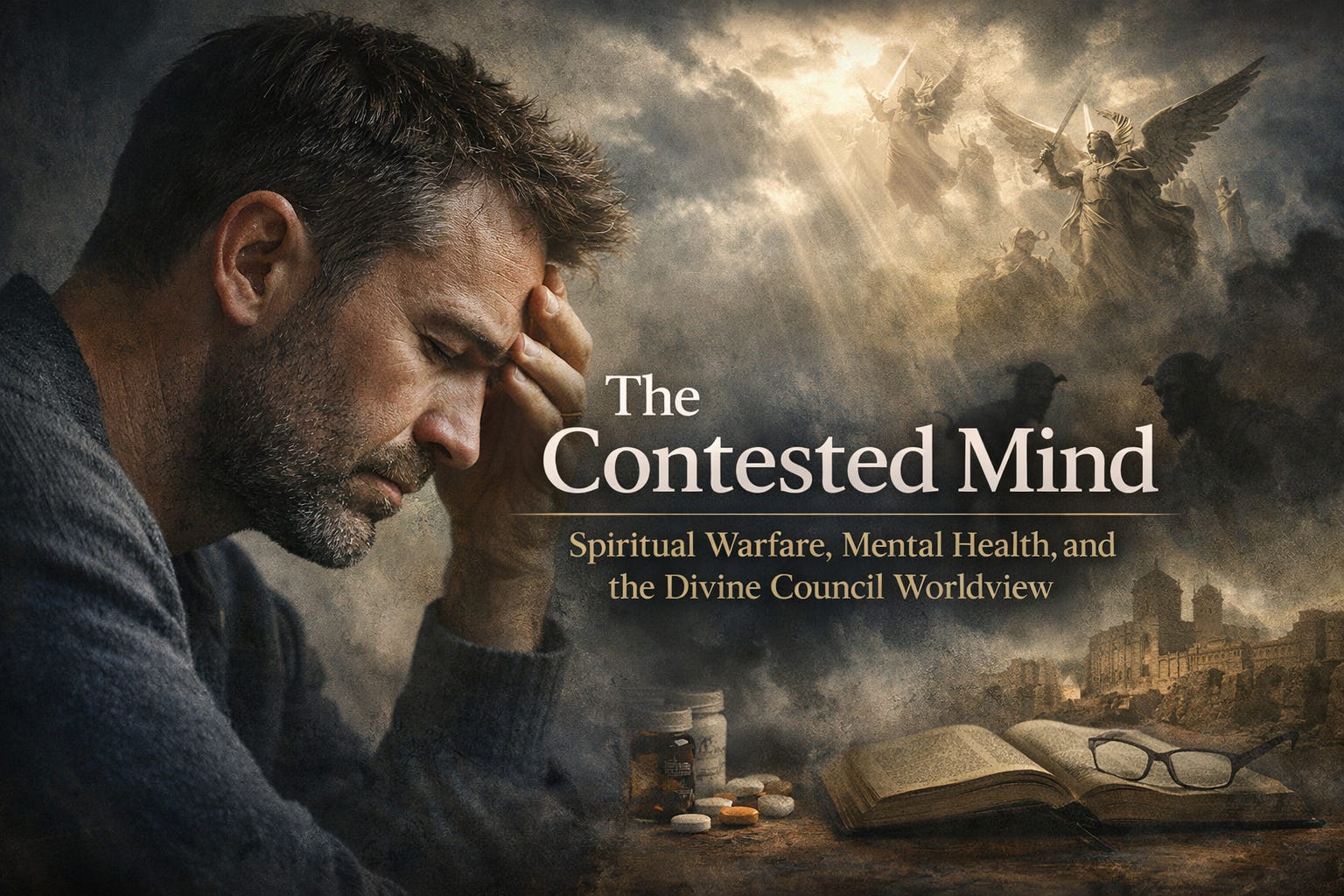
The biblical world is not mechanistic. It is not enchanted in the superstitious sense either. It is layered. Humans are embodied image-bearers living within a creation that includes visible systems and invisible powers. Eden begins with a rebel voice intruding into sacred space. The Old Testament portrays a heavenly assembly under Yahweh’s authority. The New Testament speaks unapologetically of rulers and authorities in the unseen realm. Yet those same Scriptures describe illness, grief, hunger, fatigue, and emotional collapse without attributing each one to spiritual beings.
We have inherited a modern imagination that is uncomfortable with layered causation. We prefer simplicity. But simplicity wounds people when it is not biblical.
The Divine Council worldview restores the categories we have lost. It reminds us that God reigns supremely, that humans bear responsibility, and that rebellious spiritual agents exist within creation. It also insists that embodied fragility is real. To recover that worldview is not to dramatize suffering. It is to restore proportion.
A Cosmos That Is Not Closed
When Paul writes in Ephesians that believers wrestle not merely against flesh and blood but against rulers and authorities in the heavenly places, he is not indulging poetic exaggeration. He is articulating a cosmology. The early Christian imagination was not closed. It assumed that the visible world was interwoven with invisible agency.
But notice the restraint. Paul does not say that every struggle originates directly from these powers. He situates Christian life within a contested environment without collapsing every experience into demonic causation.
This distinction is critical for mental health. Anxiety can arise from trauma. Depression can be linked to inflammation, hormonal shifts, or neurological imbalance. Intrusive thoughts can emerge from psychological conditioning. Scripture does not deny the integrity of such processes. The human person is formed from dust and animated by divine breath. Dust remains dust. The fall introduces decay into bodies as well as nations.
To deny biological causation in the name of spiritual fervor is to deny creatureliness itself.
At the same time, Scripture refuses to present the universe as spiritually sterile. The serpent’s voice in Genesis was not an internal projection. The accuser in Job was not metaphor. The rulers and authorities named in the New Testament were not merely Roman politicians. The biblical writers assume real spiritual opposition.
A Divine Council framework therefore affirms both embodiment and opposition without confusing them.
The Strategy of the Powers
If hostile spiritual beings are real, what do they actually do? The New Testament offers a consistent answer. They deceive. They accuse. They isolate. They seek to sever allegiance.
The target is loyalty.
Spiritual warfare in Scripture is rarely spectacular. It is frequently subtle. The adversary blinds minds, twists truth, and cultivates despair. The pressure applied is often not theatrical possession but persistent distortion.
This insight matters for mental health. A biological predisposition toward anxiety may exist. Trauma may rewire neural pathways. Yet deception can amplify fear. Accusation can deepen shame. Isolation can magnify despair. Spiritual opposition exploits weakness; it does not necessarily create it from nothing.
The book of Job illustrates this layered causation vividly. Job’s suffering unfolds within a heavenly council scene, yet it also includes natural disaster, human violence, bodily disease, and psychological anguish. The narrative refuses reductionism. Job’s despair is not condemned as spiritual failure. It is acknowledged as real human suffering within a world where multiple agents operate under divine sovereignty.
Such complexity should caution the modern church. Simplistic answers may offer temporary clarity, but they do not reflect Scripture’s ontology.
Discernment Without Sensationalism
If the cosmos is layered, pastoral care must be layered as well.
Discernment requires patience. It requires theological maturity capable of resisting reflex. When someone presents with mental anguish, the question is not immediately whether the cause is demonic or chemical. The question is how the various layers of reality might be interacting.
Trauma may have reshaped perception. The body may be depleted. Inflammation, hormonal imbalance, or chronic stress may be contributing factors. Deceptive narratives about God’s character may be reinforcing despair. Social isolation may be intensifying vulnerability. None of these categories exclude the others.
Prayer and therapy are not rivals. Medical treatment and spiritual discipline are not enemies. To pursue counseling does not deny spiritual warfare. To engage in prayer does not reject science. A Divine Council worldview frees the church from false dichotomies.
At the same time, caution is necessary. Deliverance language must not become the default explanation for suffering. Sensationalism destabilizes fragile souls. Yet therapeutic language must also avoid evacuating spiritual reality. The biblical cosmos remains contested. The church must resist both hyper-spiritual dramatization and sterile materialism.
Such balance is not achieved through technique but through confidence in Christ’s sovereignty. If the risen Lord reigns over rulers, authorities, synapses, and histories, then discernment can proceed calmly. We are not diagnosing symptoms in a dualistic universe. We are shepherding believers within a kingdom already secured by victory.
Living Between Worlds
Mental health struggles do not invalidate faith. They do not automatically signal demonic control, nor do they reduce existence to chemistry. They occur within a creation fractured by rebellion yet governed by Christ.
The Divine Council worldview restores the biblical vision of layered reality. It affirms biological integrity and acknowledges spiritual opposition without exaggeration. It anchors hope not in psychological invulnerability but in Christ’s cosmic authority.
The mind may be contested, but it is not abandoned.
Believers live in the tension between inaugurated victory and awaited restoration. The cross has disarmed hostile powers, yet the full renewal of creation has not arrived. Groaning remains. Anxiety may persist. Despair may surface. Neurological fragility may endure. None of these realities dethrone Christ.
Sanity in a contested cosmos is not the absence of struggle. It is persevering trust within it.
The church’s task is not to eliminate every layer of suffering through simplistic explanations. It is to cultivate allegiance that endures within complexity. When we recover Scripture’s layered worldview, we recover pastoral stability. We learn to speak honestly about biology without denying spiritual conflict, and to acknowledge spiritual conflict without denying embodiment.
And in doing so, we help suffering believers rediscover what Scripture has always proclaimed: the One who reigns over the heavenly council also sustains the fragile human mind.
Three Questions for Reflection
Have we unconsciously adopted a flattened worldview that leaves no room for spiritual opposition—or no room for biological fragility?
When someone in our churches struggles with anxiety or depression, do our instincts move toward reductionism or toward careful discernment?
What might pastoral care look like if we truly believed Christ reigns over both cosmic powers and chemical processes?
Theological Voice help pastors, scholars, and students unite Scripture, scholarship, and Spirit-led technology to see God’s Word with new eyes.