

Samson Was Not Just Strong
He Was God’s Weapon Against the Gods of the Nations

Abstract
The story of Samson in Judges 13–16 is often remembered as the account of a man with extraordinary strength who ultimately destroyed himself through moral failure. Yet when the narrative is read carefully within its biblical and ancient Near Eastern context, it becomes clear that the text is doing something far more profound. Samson is introduced as a Nazirite consecrated to God from the womb, yet his life appears to violate the very Nazirite regulations described in Numbers 6. He touches dead bodies, interacts with corpses, and repeatedly participates in violent conflict. Surprisingly, the narrative does not treat these actions as the breaking point of his consecration. Only when his hair is cut does the text state that the Lord departs from him.
This tension reveals that Samson’s Nazirite identity operates differently from the voluntary Nazirite vow described in the Torah. His consecration is imposed by divine decree and tied to a national mission rather than a temporary devotional practice. The narrative portrays Samson as a divinely empowered champion raised up to confront Israel’s enemies and expose the weakness of the gods they worship. His final act—the collapse of the temple of Dagon—stands as a theological declaration that the God of Israel remains sovereign over the nations and their deities. When read within the larger biblical framework of divine warfare, champion combat, temple symbolism, and the humiliation of rival gods, the Samson narrative emerges as a dramatic episode in the ongoing story of God asserting His rule over hostile powers through unexpected human instruments.
Introduction
Few figures in the Old Testament capture the imagination quite like Samson. His story contains all the elements that readers instinctively remember: supernatural strength, riddles, romance, betrayal, violence, and tragedy. He tears a lion apart with his bare hands, slays a thousand enemies with the jawbone of a donkey, and carries city gates on his shoulders. Yet the same man who performs these astonishing feats ends his life blind, imprisoned, and crushed beneath the ruins of a Philistine temple.
Because of these dramatic elements, Samson is often remembered primarily as a strongman whose personal weaknesses undermined his calling. But the biblical narrative itself insists that something far more significant is unfolding. Samson’s strength is repeatedly attributed to the Spirit of the Lord rushing upon him. His life begins not with heroic training but with an angelic announcement declaring that he will be a Nazirite to God from the womb and that he will begin delivering Israel from the hand of the Philistines.
From the very beginning, Samson is set apart for a mission.
Yet that mission quickly raises difficult questions. The Nazirite vow described in Numbers 6 required strict separation from sources of impurity. Nazirites were forbidden to touch dead bodies and were expected to live lives of visible dedication to God. Samson, however, repeatedly interacts with corpses and participates in violent encounters that seem incompatible with those rules. At first glance, the narrative appears contradictory.
The key to resolving this tension lies in recognizing that Samson’s consecration is not simply a personal vow but a divine appointment tied to Israel’s deliverance. His story must therefore be read within a broader biblical framework involving divine warfare, representative champions, and the humiliation of rival religious systems.
When viewed in that light, Samson emerges not merely as a flawed hero but as a divinely empowered instrument in a larger conflict between the God of Israel and the powers that oppose Him.
Samson the Champion in a War of Gods
Ancient warfare often included the practice of representative combat in which individual warriors confronted one another as champions of their people. The champion embodied the strength, honor, and authority of the community he represented. When he fought, he fought not merely for himself but for the nation behind him.
The Samson narratives reflect this pattern in striking ways. Unlike other judges who gathered armies and organized campaigns, Samson fights almost entirely alone. His conflicts with the Philistines begin as personal encounters but quickly escalate into events that impact entire regions. When he defeats Philistine forces, the victories are presented as manifestations of divine empowerment rather than personal achievement.
The narrative repeatedly describes the Spirit of the Lord rushing upon him, emphasizing that Samson’s strength is not inherent but granted by God. Each victory therefore becomes a demonstration of divine authority over Israel’s enemies.
This pattern appears elsewhere in the biblical story. One of the most famous examples occurs when David confronts Goliath in single combat. The towering Philistine champion embodies military power and intimidation, yet David insists that the battle belongs to the Lord. The outcome of the duel reveals not merely the courage of a young shepherd but the supremacy of Israel’s God over the gods of the Philistines.
Samson functions in a similar role within the book of Judges. Though personally flawed and often impulsive, he becomes the instrument through which Yahweh repeatedly humiliates Philistine power. His victories remind Israel that their security does not ultimately depend on military strength but on the presence of the God who fights for His people.
Sweetness From Death
One of the most intriguing episodes in Samson’s life occurs early in the narrative when he encounters a lion along the road to Timnah. The text describes how the Spirit of the Lord rushes upon him and he tears the animal apart with his bare hands. Later he returns to the site and discovers something unexpected. Bees have formed a hive inside the carcass of the lion, and honey now fills the body of the animal.
From this strange discovery Samson creates a riddle that he later presents at his wedding feast: “Out of the eater came something to eat; out of the strong came something sweet.”
The image is both vivid and symbolic. The predator that once represented danger and destruction now becomes the source of nourishment. The carcass of a slain beast produces sweetness.
The symbolism anticipates the pattern that will define Samson’s life. Throughout the narrative, destruction becomes the means through which deliverance emerges. The defeat of powerful enemies produces unexpected blessing for Israel. The riddle therefore captures the paradox at the heart of the story: from the downfall of strength comes unexpected provision.
When Temples Fall
The climax of Samson’s story unfolds inside the temple of the Philistine god Dagon. After Samson’s capture, the Philistines gather to celebrate what they believe is a decisive victory. Their god, they proclaim, has delivered their enemy into their hands.
Samson is brought into the temple as a spectacle for their entertainment.
But the setting is more than theatrical. In the ancient world temples represented the dwelling place of a god and the center of cosmic order associated with that deity. Architectural features such as pillars symbolized stability and permanence within the divine order that the temple represented.
Samson is positioned between two central pillars that support the structure.
Blind and weakened, he asks to rest against them. Then he prays.
His prayer is simple. He asks God to remember him and grant him strength one final time.
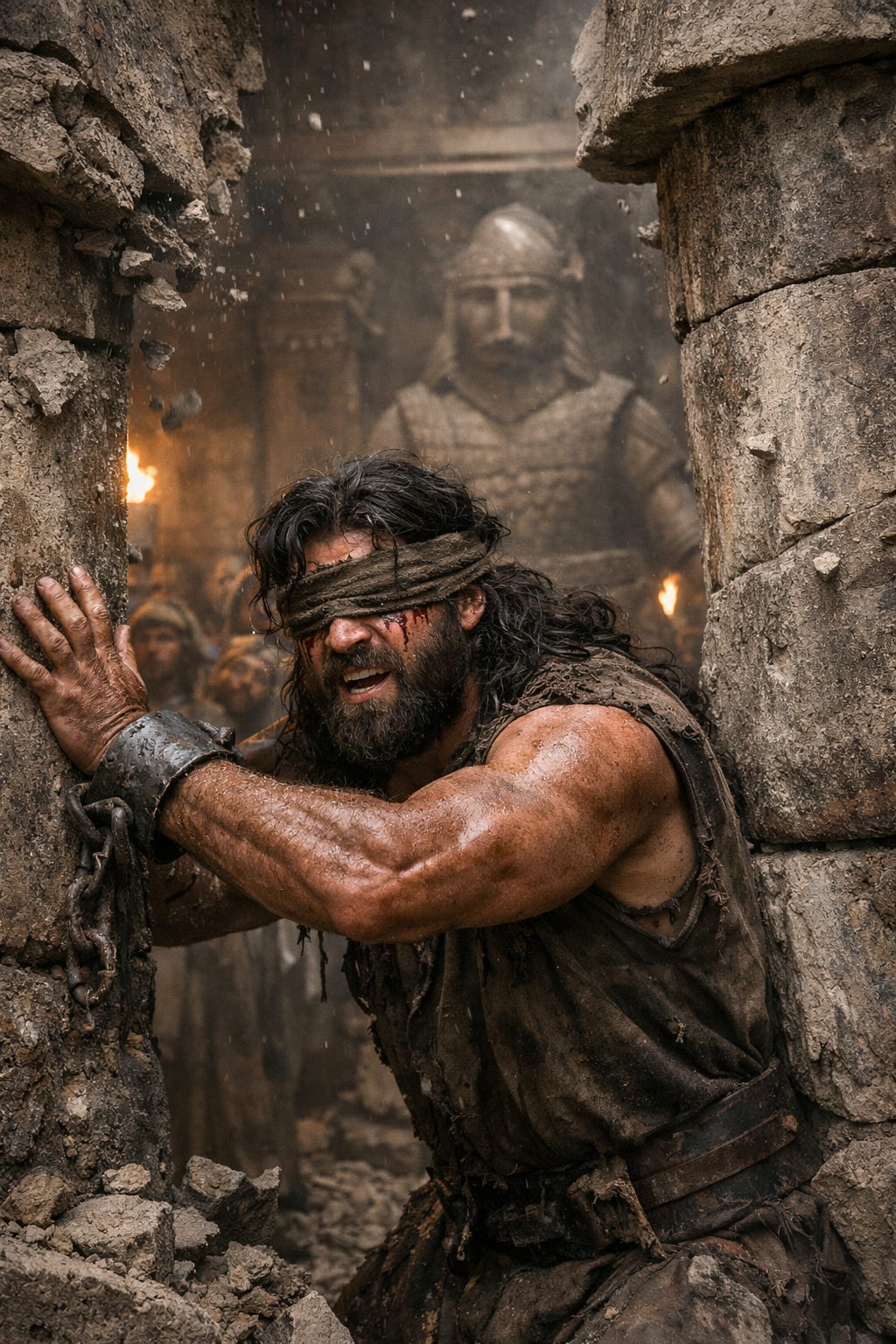
When Samson pushes against the pillars, the temple collapses. Thousands gathered inside the sanctuary perish beneath the falling structure.
The symbolism is unmistakable. The sanctuary dedicated to Dagon cannot stand against the power of the God of Israel. The religious system that celebrated its triumph becomes the site of its humiliation.
The Fall of Dagon
This event echoes an earlier moment in Israel’s history when the Ark of the Covenant was placed inside a temple dedicated to Dagon. On the following morning the statue of the Philistine god was found fallen face down before the Ark. When it was set upright again, it fell a second time, this time with its head and hands severed.
In both stories the same theological message emerges. The God of Israel is not merely another regional deity competing with others. He demonstrates His authority even within the sanctuaries of foreign gods.
Samson’s final act intensifies that message. Thousands gather in the temple to celebrate Dagon’s supposed victory over Israel. Instead, the sanctuary collapses around them.
The place that symbolized the strength of Philistine religion becomes the place of its downfall.
Victory Through Weakness
Perhaps the most remarkable feature of Samson’s final victory is the condition in which it occurs. By the time he stands inside the temple, Samson has been blinded and enslaved. The once-feared warrior now grinds grain like a prisoner.
To the Philistines, this humiliation proves that their god has triumphed.
But the narrative reveals a deeper reality.
Samson’s final prayer acknowledges that his strength never belonged to him. The power that once enabled him to defeat enemies came from God alone. When that strength returns for a final moment, the entire structure of Philistine power collapses.
This pattern appears throughout Scripture. Again and again, God accomplishes victory through unexpected instruments. He chooses individuals who appear weak, unqualified, or defeated so that the outcome will clearly reveal His authority.
Samson’s final act embodies this principle in dramatic form. The moment that appears to confirm defeat becomes the moment of divine triumph.
A Mirror of Israel’s Crisis
Samson’s life also reveals something troubling about the spiritual condition of Israel during the period of the judges.
The book repeatedly describes the era with a haunting refrain: there was no king in Israel, and everyone did what was right in his own eyes.
Samson reflects that instability. Though chosen by God and empowered by His Spirit, he lives impulsively and often recklessly. His personal failures mirror the broader disorder of the nation he serves.
This tension is intentional. The story shows that God continues to rescue Israel even when its leaders are flawed. At the same time, Samson’s weaknesses reveal the limitations of the judges themselves.
Israel needs more than sporadic deliverance.
It needs faithful leadership.
The narrative therefore prepares the reader for what will come next in the biblical story: the emergence of kingship and ultimately the expectation of a ruler who will unite divine authority with covenant faithfulness.
Engaging Questions
Why does the Samson narrative allow actions that appear to violate Nazirite law while still presenting Samson as consecrated to God?
What does the collapse of Dagon’s temple reveal about how the Bible portrays conflicts between Yahweh and the gods of the nations?
How does Samson’s final victory illustrate the biblical pattern that God often accomplishes His greatest work through human weakness?
Theological Voice help pastors, scholars, and students unite Scripture, scholarship, and Spirit-led technology to see God’s Word with new eyes.
Thank you Dale for sharing this writing. It was such an interesting read this morning. I enjoyed the thought that a nazrite set apart from birth was indeed a different calling and mandate as opposed to a decision to undertake the Nazrite vow later in life. Those who were set apart as Nazrites from birth generally came from mothers who were barren also so I wonder if indeed as with the Messiah and John that the Ruach / spirit actually filled inutero. There is also an interesting concept called Bugonia tied to ancient times where bees are said to be inherent or dormant inside an animal and come out once the animal dies. An interesting study in itself and perhaps given this was an ancient concept it was actually known on those days hence Samson's riddle to them. Also enjoyed your thought that these early stand alone messengers and weapons of YHWH were replaced / upgraded by covenant connected Kingship ruling.
I'm not sure if this is one article with more to come out of it, like a series or a part two? The last paragraph seems to lean this way. If not, I wish the article made a deeper connection to Christ and His work. Otherwise, I recognize and appreciate the illumination the article brings. Thank you!